
A patient may come to a cardiologist saying, “I am getting tired much faster than I used to. Even climbing a few stairs leaves me exhausted.” Often, the first thought is lack of sleep, stress, or simply getting older. Sometimes, that is exactly what it is. But when this change is new, persistent, or accompanied by other symptoms, it would not be recommended to ignore it.
Fatigue can sometimes be a sign that the heart is not working as efficiently as it should. The key is to recognize when ordinary tiredness starts looking different from the fatigue associated with a cardiovascular problem.
Can Fatigue Be a Sign of Heart Disease?
Yes, fatigue can be one of the symptoms of heart disease, particularly when it is persistent or occurs with reduced exercise capacity, breathlessness, or other cardiac symptoms.
The heart’s job is to pump oxygen-rich blood throughout the body. When a cardiovascular condition affects how efficiently the heart pumps or how much blood reaches the heart muscle, everyday activities can start feeling unusually demanding.
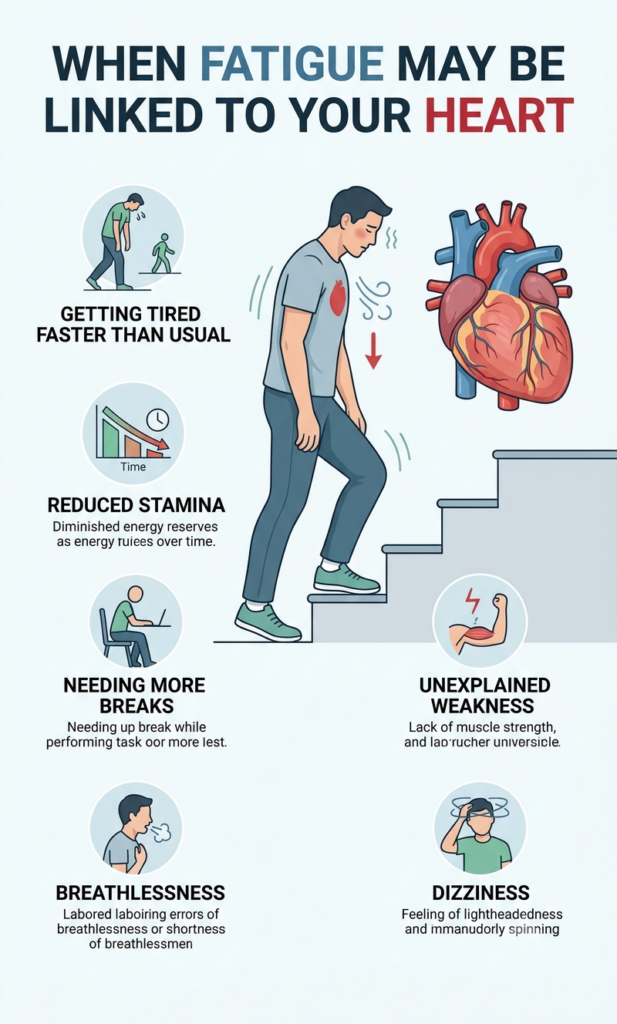
You may notice that you:
- Get tired doing activities that were previously easy
- Need more breaks while walking or climbing stairs
- Have less stamina than usual
- Feel unusually weak without an obvious reason
- Become tired along with breathlessness or dizziness
Fatigue by itself does not mean you have heart disease. But a noticeable change in your usual energy or exercise capacity deserves attention, especially if it continues.
Why Can Heart Problems Cause Fatigue?
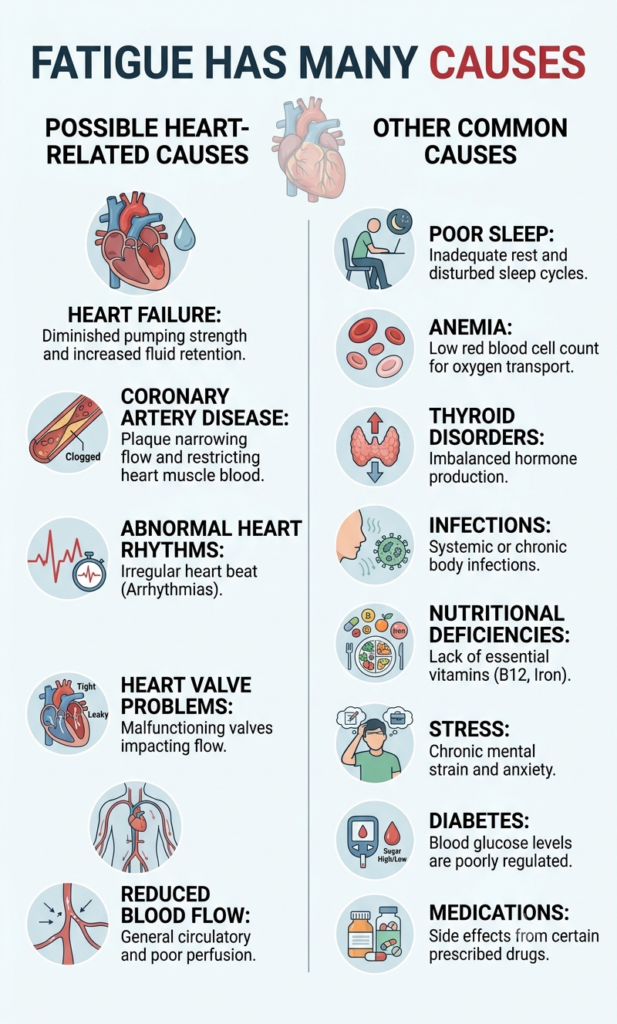
Heart problems can cause fatigue when the heart or circulation cannot adequately meet the body’s demand for blood and oxygen.
For example, in heart failure, the heart’s pumping ability may be reduced. In coronary artery disease, blood flow to the heart muscle may be restricted. Certain arrhythmias can make the heartbeat too fast, too slow, or irregular, while heart valve problems can place additional strain on the heart.
The result can be surprisingly simple from a patient’s perspective: activities that once felt normal suddenly require much more effort. This is why it is important to pay attention — not only to whether a patient feels tired, but also to when the fatigue occurs, what activities trigger it, and whether their exercise capacity has changed.
Heart-related fatigue is often noticed as a change in your usual stamina rather than simply feeling sleepy. For example, you may find yourself stopping halfway while climbing stairs, feeling unusually exhausted after a short walk, or needing significantly more recovery time after routine physical activity.
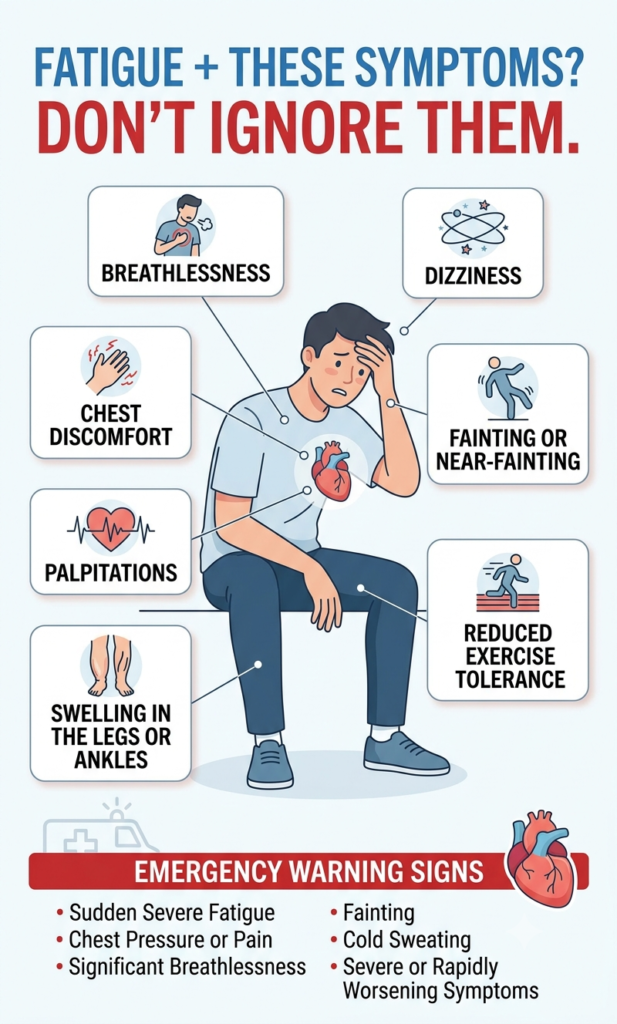
Fatigue becomes more important to investigate when it appears alongside:
- Breathlessness, particularly during activity
- Chest pain, pressure, or discomfort
- Palpitations or an irregular heartbeat
- Dizziness or light-headedness
- Fainting or near-fainting
- Swelling around the ankles or legs
- A noticeable decline in exercise tolerance
These symptoms do not automatically indicate heart disease, but their combination can provide important clues during a cardiac evaluation.
Fatigue and Heart Disease: Warning Signs You Should Not Ignore
The biggest red flag is not simply being tired. It is a new or unexplained change in how your body handles activity. Pay attention if you are experiencing fatigue together with:
- Breathlessness: Getting unusually breathless while walking, climbing stairs, or performing routine activities can sometimes indicate a cardiovascular problem.
- Chest discomfort: Pressure, tightness, or discomfort in the chest, particularly during physical activity, should never be casually dismissed.
- Palpitations: A racing, pounding, or irregular heartbeat accompanied by weakness or fatigue may require assessment for a heart rhythm problem.
- Dizziness or fainting: Repeated dizziness, especially during exertion, or unexplained fainting warrants medical evaluation.
- Reduced exercise tolerance: If a walk that was comfortable a few months ago now leaves you exhausted, that change is worth discussing with a doctor.
- Swelling in the legs or ankles: Swelling, particularly when accompanied by breathlessness and fatigue, can occur with certain heart conditions.
No. Fatigue has many possible causes, and heart disease is only one of them. Poor sleep, anemia, thyroid disorders, infections, nutritional deficiencies, stress, diabetes, and some medications can all leave you feeling persistently tired.
This is why it is important not to self-diagnose based on fatigue alone. A cardiologist looks at the complete picture: your symptoms, medical history, risk factors, examination findings, and, when needed, diagnostic tests.
The goal is not to assume that every episode of tiredness is a heart problem. It is to make sure a potentially important cardiac cause is not overlooked.
When Should You See a Cardiologist for Fatigue?
You should consider a cardiac evaluation if fatigue is persistent, unexplained, progressively worsening, or affecting your normal physical activity. We would be particularly cautious if fatigue is accompanied by chest discomfort, breathlessness, palpitations, dizziness, fainting, or a significant reduction in exercise capacity.
For patients in Delhi NCR, consulting an experienced cardiologist such as Dr. Naveen Bhamri can help determine whether these symptoms are related to the heart or have another underlying cause.
How is Fatigue Evaluated for Possible Heart Problems?
There is no single test that determines whether fatigue is caused by heart disease. The evaluation depends on the patient’s symptoms and clinical history. A cardiologist may consider:
- Blood pressure and physical examination
- ECG to assess the heart’s electrical activity
- Echocardiography to evaluate heart structure and function
- Blood tests when indicated
- Stress testing to assess the heart during exertion
- Holter monitoring when an abnormal rhythm is suspected
Not every patient needs all of these tests. The investigation should be guided by the symptoms and clinical findings.
When is Fatigue an Emergency?
Do not wait for a routine appointment if severe fatigue occurs suddenly with chest pressure or pain, significant breathlessness, fainting, cold sweating, or other severe symptoms. These can be warning signs of an acute cardiovascular problem and require urgent medical attention.
For patients in Delhi NCR looking for expert cardiac evaluation, Dr. Naveen Bhamri, Chairman & Head of Department of Cardiac Sciences and Interventional Cardiology at Max Super Speciality Hospital, Shalimar Bagh, and Chairman & Unit Head at BLK-Max Hospital, brings over 27 years of dedicated experience in interventional cardiology. With extensive experience in 50,000+ coronary angiographies, 20,000+ angioplasties, 1,500+ cardiac device implantations, and 70+ TAVI procedures, he can provide comprehensive evaluation when symptoms raise concerns about heart health.
The Bottom Line
Your body often notices a change before you have a name for it. If everyday activities are suddenly leaving you much more exhausted than before, do not automatically put it down to age, stress, or a busy schedule.
Fatigue is usually caused by something other than heart disease, but when it is persistent or accompanied by other heart disease symptoms, it deserves attention.
A timely cardiac assessment helps you identify whether the cause is related to the heart, and if it is not, it can point you towards the right next step.
FAQs About Fatigue and Heart Disease
Can fatigue be a sign of heart disease?
Yes. Persistent or unusual fatigue can sometimes be associated with heart disease, especially when it occurs with breathlessness, reduced exercise tolerance, chest discomfort, dizziness, or palpitations.
Can heart problems cause fatigue without chest pain?
Yes. Not every heart problem causes chest pain. Some people may primarily notice fatigue, breathlessness, weakness, or a decline in their ability to exercise.
What are the early signs of heart disease?
Early signs can vary, but unusual fatigue, reduced exercise tolerance, breathlessness, chest discomfort, palpitations, and dizziness can be potential warning signs. Their significance depends on the individual’s overall clinical picture.
Should I see a cardiologist for unexplained fatigue?
If fatigue is persistent, worsening, or affecting your usual activities, particularly when accompanied by other cardiovascular symptoms, it is reasonable to seek medical evaluation.