
A racing heartbeat that suddenly slows down. A dizzy spell that passes in seconds. A fainting episode with no clear explanation. Most patients brush these moments aside, assuming they are linked to low blood pressure, dehydration, or simply “getting older”. Sometimes that is true. Sometimes it is not.
These symptoms can be early signs of a heart rhythm disorder — a condition where the heart’s electrical system either beats too slowly, too quickly, or irregularly. For many patients, the long-term solution is not a daily tablet but a small device that quietly corrects the rhythm from inside the chest: a pacemaker, or in more serious cases, an AICD (defibrillator).
If you are searching for a pacemaker specialist in India or trying to understand pacemaker surgery cost in Delhi, this guide explains what these devices actually do, who needs them, what the procedure involves, and what daily life looks like afterward.
What Is a Pacemaker, and How Is It Different From an AICD?
The heart has its own natural electrical system that generates each heartbeat. When this system malfunctions — beating too slowly, skipping beats, or developing dangerous fast rhythms — a small implantable device can take over part of this job.
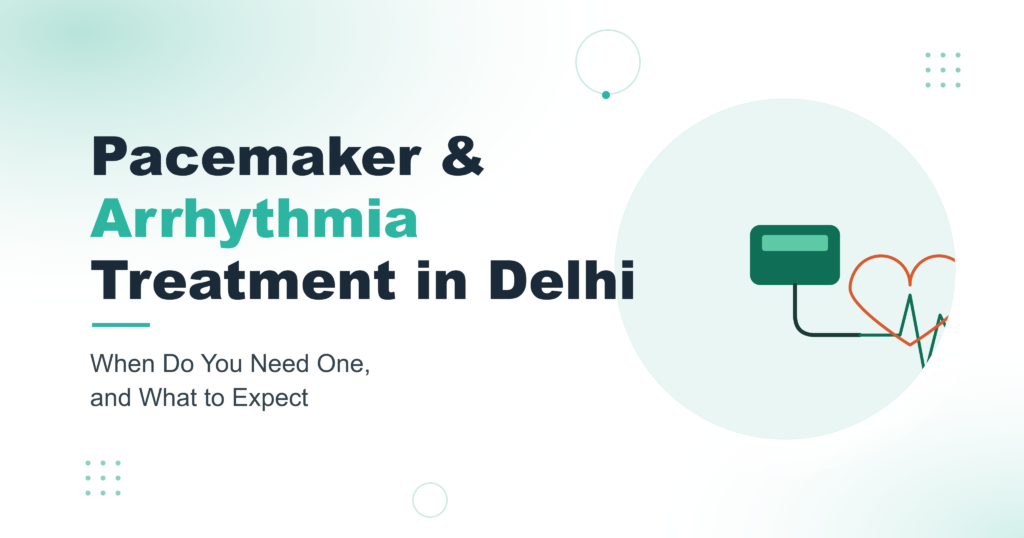
Patients often use the words “pacemaker” and “defibrillator” interchangeably, but they serve different purposes. A pacemaker continuously monitors the heart and sends small electrical signals when the heart beats too slowly, keeping the rate steady. An AICD (Automatic Implantable Cardioverter Defibrillator) does everything a pacemaker does, but also delivers a corrective shock if it detects a dangerous, life-threatening fast rhythm — the kind that can cause sudden cardiac arrest.
A CRT-D (Cardiac Resynchronisation Therapy with Defibrillator) is a more advanced device used in certain heart failure patients. It coordinates the timing between the heart’s chambers so they pump together more efficiently, while also providing defibrillator protection.
| Device | Primary Purpose |
| Single-Chamber Pacemaker | Corrects slow heart rate in one heart chamber |
| Dual-Chamber Pacemaker | Coordinates timing between two heart chambers |
| Leadless Pacemaker | Capsule-sized device placed directly inside the heart, no wires |
| AICD (Implantable Defibrillator) | Detects and corrects dangerous fast rhythms; prevents sudden cardiac arrest |
| CRT-D (Biventricular Device) | Improves pumping coordination in heart failure with rhythm protection |
Symptoms That May Indicate a Rhythm Problem
Rhythm disorders do not always cause dramatic symptoms. Some patients feel nothing at all and are diagnosed only during a routine ECG. Others experience symptoms that come and go, making them easy to dismiss.
| Symptom | Why It May Indicate a Rhythm Problem |
| Frequent dizziness or lightheadedness | May suggest the heart is beating too slowly |
| Fainting or blackout episodes (Syncope) | Can occur when the heart pauses or skips beats |
| Palpitations — fluttering or pounding heartbeat | May indicate an abnormal electrical rhythm |
| Extreme fatigue with normal activity | Heart may not be pumping enough blood per beat |
| Breathlessness with swelling in legs | May suggest rhythm disorder affecting heart failure |
| Slow pulse (below 50 bpm) without medication cause | May indicate heart block or sick sinus syndrome |
If you are experiencing recurring episodes of dizziness, fainting, or palpitations, consulting a chest pain and heart rhythm specialist near you in Delhi is the safest first step. Many patients delay this consultation because individual episodes feel minor — but recurring episodes deserve proper evaluation, especially in patients above 50 or those with diabetes, hypertension, or prior heart disease.
Conditions That Commonly Require a Pacemaker
Bradycardia (Slow Heart Rate): When the heart beats too slowly to meet the body’s oxygen demands, patients experience fatigue, breathlessness, and dizziness. A pacemaker restores a normal heart rate by stepping in whenever the natural rhythm drops too low.
Heart Block: This occurs when the electrical signal from the upper chambers of the heart does not reach the lower chambers properly. Depending on severity, heart block can cause mild symptoms or sudden fainting episodes. Complete heart block is one of the most common reasons for pacemaker implantation.
Sick Sinus Syndrome: The heart’s natural pacemaker (the sinus node) malfunctions, causing the heart rate to alternate between too slow and too fast. This is more common in older adults and often requires a permanent pacemaker for long-term management.
Atrial Fibrillation with Slow Rates: Some patients with atrial fibrillation develop episodes where the heart rate drops dangerously low, particularly during sleep. A pacemaker can provide a safety backup while other medicines manage the irregular rhythm.
Leadless Pacemakers: A Modern Alternative
Traditional pacemakers consist of a small device implanted under the skin near the collarbone, connected to the heart through one or more wires (leads) that travel through blood vessels. While highly reliable, these leads can occasionally develop complications over many years, such as infection or lead fracture.
A leadless pacemaker eliminates this concern entirely. It is a capsule-sized device, smaller than a vitamin tablet, that is placed directly inside the heart chamber through a catheter inserted via the femoral vein — without any chest incision, wires, or visible device under the skin. This is particularly useful for elderly patients, those with prior infections, or patients who need only single-chamber pacing.
Dr. Naveen Bhamri is among the leading interventional cardiologists in Delhi NCR offering leadless pacemaker implantation, reflecting his focus on minimally invasive options wherever clinically appropriate.
What Happens During Pacemaker Implantation
Pacemaker implantation is typically performed under local anaesthesia with mild sedation, meaning patients remain comfortable but do not require general anaesthesia or a long hospital stay in most cases.
For a conventional pacemaker, a small incision is made below the collarbone. One or two thin leads are guided through a vein into the heart chambers under live imaging guidance, and their position is carefully tested before the device is connected and placed under the skin. The entire procedure usually takes 45 minutes to about 1.5 hours, depending on whether a single-chamber, dual-chamber, or CRT-D device is being implanted.
For a leadless pacemaker, the device is delivered through a catheter inserted in the upper thigh and guided directly into the heart, where it attaches to the heart wall. There is no chest incision and no visible device under the skin.
Recovery After Pacemaker or AICD Implantation
Recovery is generally quick, and most patients return to a near-normal routine within a few weeks.
| Recovery Phase | What Patients Usually Experience |
| First Few Hours | Monitoring in the recovery area; chest X-ray to confirm lead position |
| First 24 Hours | Mild soreness near the implant site; arm movement kept limited |
| 1–2 Days | Hospital discharge in stable cases |
| 1–2 Weeks | Gradual return to routine activity; avoid heavy lifting on the implant side |
| 4–6 Weeks | Device check-up; most normal activities can usually resume |
Patients are advised to avoid raising the arm on the implant side above shoulder height for the first few weeks, to allow the leads to settle into position. Regular device check-ups — either in-person or through remote monitoring — help confirm the device is functioning correctly and the battery is performing as expected.
Living With a Pacemaker: Practical Guidance
Mobile Phones and Electronics: Most everyday devices, including smartphones, laptops, and household appliances, are safe to use normally.
Driving: Most patients can resume driving within a short period after implantation, once cleared by their cardiologist, particularly for pacemakers implanted for non-emergency reasons.
Airport Security and MRI Scans: Patients should carry their device identification card when travelling, as pacemakers can be detected at security checkpoints. Most modern pacemakers are MRI-compatible, but this should always be confirmed with the implanting cardiologist before any MRI scan.
Battery Life: Pacemaker batteries typically last several years depending on usage and device type. Routine follow-up visits monitor battery status well in advance, so replacement can be planned rather than urgent.
Does Insurance Cover Pacemaker Surgery?
Pacemaker and AICD implantation is generally classified as a medical necessity and is covered by most private insurance policies, subject to policy terms, room rent limits, and device-specific sub-limits. Government schemes such as CGHS, ECHS, and Ayushman Bharat may also support eligible patients for device implantation.
Because device costs can vary significantly depending on the type — single-chamber, dual-chamber, leadless, AICD, or CRT-D — patients are encouraged to discuss device selection, insurance approval, and TPA documentation with the hospital’s insurance desk before admission to avoid delays.
When Should You See a Cardiologist for Rhythm Symptoms?
Do not wait for a fainting episode to seek evaluation. If you experience recurring dizziness, palpitations, unexplained fatigue, or a consistently slow pulse, an ECG and rhythm assessment can identify the problem early — often before it becomes an emergency.
As one of the best interventional cardiologists in Delhi, Dr. Naveen Bhamri has performed more than 1,500 cardiac device implants, including pacemakers, AICDs, CRT-D devices, and leadless pacemakers. Treatment decisions are based on the type of rhythm disorder, overall heart function, and each patient’s lifestyle needs — not a one-size-fits-all approach.
FAQs
How do I know if I need a pacemaker or just medication?
This depends on the type of rhythm disorder. Fast rhythms can sometimes be managed with medication alone, but slow rhythms caused by heart block or sick sinus syndrome usually cannot be corrected with medicines — a pacemaker is the definitive treatment. An ECG, Holter monitor, and sometimes an electrophysiology study (EPS) help determine which approach is appropriate.
Is pacemaker surgery a major operation?
No. Pacemaker implantation is a minimally invasive procedure performed under local anaesthesia with sedation, not general anaesthesia. Most patients are discharged within 1–2 days and resume normal activities within a few weeks.
What is the difference between a pacemaker and a leadless pacemaker?
A conventional pacemaker is placed under the skin near the collarbone and connected to the heart through wires (leads). A leadless pacemaker is a small capsule placed directly inside the heart through a catheter in the leg, with no wires and no visible device under the skin. Not all patients are candidates for a leadless device — suitability depends on the type of pacing required.
Can a pacemaker patient lead a normal life?
Yes. Most pacemaker patients return to their normal daily routine, including work, travel, and most forms of exercise, within a few weeks of implantation. Regular follow-up visits ensure the device continues to function correctly.
How often does a pacemaker need to be replaced?
Pacemaker batteries typically last several years, depending on the device type and how frequently it is used. Routine check-ups monitor battery life well in advance, so replacement of the device (not the leads, in most cases) can be planned ahead of time.
Is an AICD the same as a pacemaker?
No. An AICD includes pacemaker functions but also monitors for dangerous fast heart rhythms and can deliver a corrective shock if needed, to prevent sudden cardiac arrest. AICDs are typically recommended for patients at higher risk of life-threatening arrhythmias, such as those with significant heart muscle weakness or a history of dangerous rhythm episodes.